Section 19 · Safety, Deliverability & Governance
19.7Version history
Built in the POC- No.
- 19.7
- DMA's reference
- Decision Book p.35
- Phase
- Phase 1
- Autonomy
- L4 · Autonomous
- DMA's decision
- Yes
What DMA asked for · Decision Book p.35
Know exactly which instructions and knowledge the AI was using when a conversation happened.
Why it matters to DMA: Essential for debugging a bad conversation, and for any future liability question.
In our words, from DMA's Product Decision Book v3, page 35.
How we do it
- Instructions, agent configurations, rules and knowledge documents are all versioned; a change is a new version, and old versions are kept.
- Every AI decision is logged with the version of the instructions and configuration that made it, the model, the checks that fired, and its cost. Every message the AI writes records its agent version too.
- Knowledge snapshots record which versions of the approved documents were live, so "what did the chat know on that day" has an exact answer.
- Observe shows any reply as a trace: from the visitor's message, through the rule checks and the model call, to the logged decision.
The flow
It plays on its own while it's on screen; hover or use the controls to pause or step through.
A question
"Why did the chat say that on June 3?"
- Screen
- Stored data
Where the data goes
The same six stages on every page. Nothing reaches Nutshell except through the write gate.
- 1Every AI action
Source
Replies, drafts, scores.
- 2Sync
Copies Nutshell changes into the bridge database
Not involved.
- 3Bridge database
A copy of the CRM data, plus what the AI works out
Every version, every decision and every model call.
- 4AI
Claude models, only through DMA's own gateway
Each call is tagged with its version.
- 5Write gate
The only way back into Nutshell: checked, approved when needed, sent once
Writes carry the decision that made them.
- 6Nutshell
The system of record
Unchanged.
The tables behind it
Drawn from the POC's database catalogue: structure only, no data.
PK primary keyFK reference the database enforces (solid line)ID reference kept by id (dashed line)
| Table | What it holds | Columns |
|---|---|---|
| ctrl.decision_log | Every AI decision: its version, model, checks, tokens and cost. | 28 |
| agent.prompts | Every version of every instruction. | 14 |
| ai.kb_snapshots | Which document versions were live together. | 5 |
How the tables connect (3)
| Column | Points to | Kept by |
|---|---|---|
| ctrl.decision_log.agent_version_id | agent.agent_versions | The application (by id) |
| ctrl.decision_log.run_id | agent.runs | The application (by id) |
| ctrl.decision_log.conversation_id | conv.conversations | The application (by id) |
Worked example
Synthetic demo data: every name, business and number is made up.
One reply, traced back
What you see
1.The trace
Observe shows one website-chat reply, step by step.
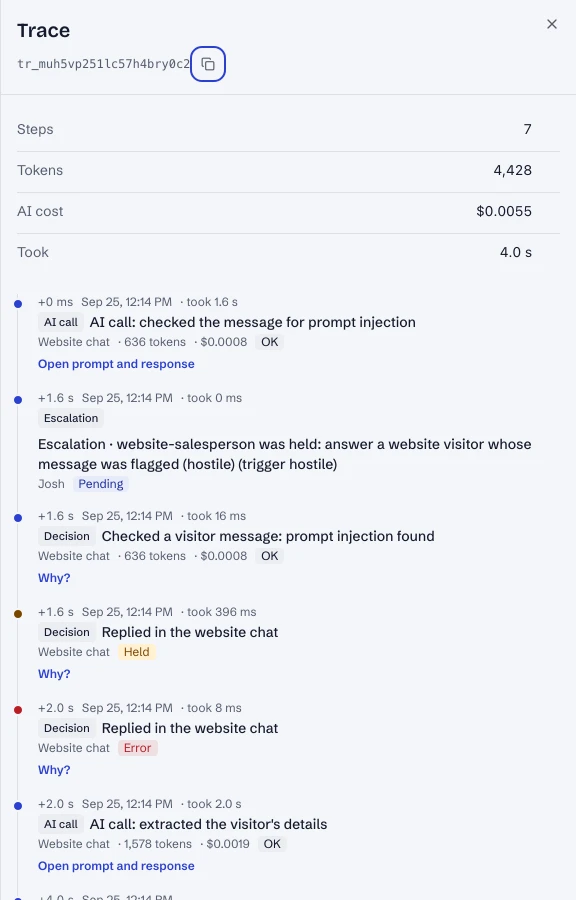
What happens in the system
- Bridge database
ctrl.decision_logEach step is a logged decision with its version and checks.
One reply, as the decision log records it (from a real POC run).
A logged reply
- Agent
- Website salesperson
- Instructions
- website-salesperson, the version live at the time
- Model
- Claude Sonnet 5, through DMA's gateway
- Checks
- Input classified; every sentence passed the claims check
- Cost
- Recorded to the thousandth of a cent
In the running POC
1 / 2Observe: one website-chat reply as a trace of steps.
- 1The steps of the reply, in order.
- 2Open the model call itself.
Dashboard · Observe, the trace of one website-chat reply. Captured from the running POC on September 25, 2026; synthetic data.
See it live
Opens the exact screen in the running POC, in a new tab.
| Open | Where | What to try |
|---|---|---|
| Observe | DMA AI dashboard | Open any row to see its trace. |
Status
Built in the POC. This capability runs in the POC today, on synthetic data, end to end.